Armed and Ready
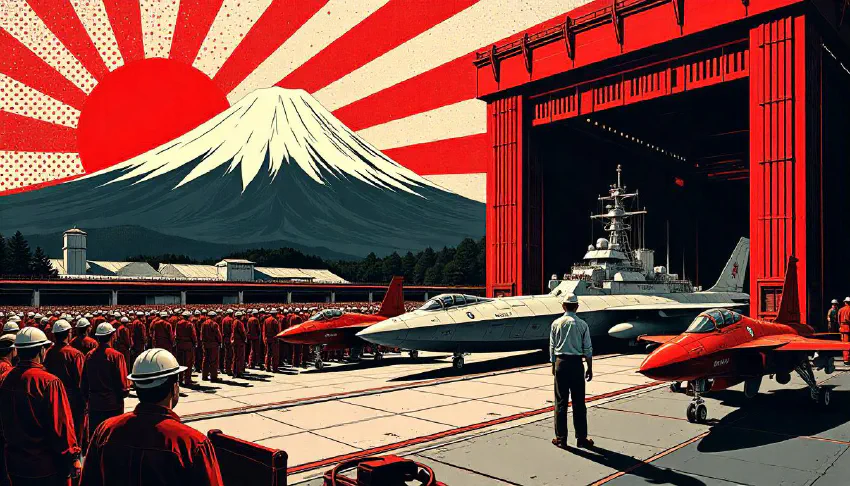
For 80 years, Japan’s defence industry has been one of the best-kept secrets in global manufacturing. Capable of building stealth frigates, fighter jets, advanced radar systems, and precision missiles. Constrained by post-war pacifism to sell exactly none of it to the outside world.
That just changed.
Last week, Japan’s ruling party approved a sweeping overhaul of its arms export rules — removing the restrictions that confined overseas sales to five narrow categories and opening the door to virtually the full spectrum of what its defence industry produces. Prime Minister Sanae Takaichi’s government is expected to formally adopt the changes as soon as this month.
This is a regime change. Not a tweak. Not an incremental policy adjustment. An 80-year-old door just swung open.
And because it happened the same week the US-Iran war dominated every headline, almost nobody in the investment community is talking about it.
That’s the opportunity.
The Story Everyone Is Watching. And The One They’re Missing.
Markets have been pricing Japan’s defence buildup for a while now. Since 2022, when Tokyo announced it would double defence spending to 2% of GDP, Japanese defence stocks went on a sustained run. Kawasaki Heavy Industries surged 17% in a single day after Takaichi’s LDP won its supermajority in February. Mitsubishi Heavy Industries hit an all-time high of ¥5,208 in early March.
Investors understood the domestic story: bigger budget, same contractors, more revenue. Simple math.
What they haven’t priced is something fundamentally different. Japan’s defence manufacturers aren’t just getting a larger domestic order book. They’re getting the right to sell to the world. That’s not the same story. That’s not even close to the same story.
Strip away the noise of the Iran war headlines and what emerges is this: an entire advanced defence industrial ecosystem — sealed off from global markets for generations — just got its export licence.
An Industry That’s Been Hidden In Plain Sight
Here’s what most Western investors don’t appreciate. Japan never stopped building sophisticated weapons. It just only built them for one customer.
Japan currently spends $66.5 billion annually on defence — the fourth largest military budget in the world. That’s enough to sustain an industry capable of manufacturing Mogami-class stealth frigates, advanced diesel submarines, the F-2 fighter jet, hypersonic missile defence systems, and cutting-edge radar and electronic warfare equipment.
According to SIPRI’s analysis of defence contractor revenues, Japan’s arms industry is on a par with South Korea, Germany, Italy and Israel. Nearly twice the size of India’s.
The industry has been running at scale for decades. It just had no export revenue.
Now it does.
Korea Wrote The Playbook. Japan Is About To Run It.
If you want to understand what happens when a sophisticated Asian defence industry gets export freedom, look at South Korea. Korea’s trajectory is the closest real-world parallel we have.
The numbers are extraordinary. South Korea’s four largest defence firms — Hanwha Aerospace, Hyundai Rotem, LIG Nex1 and Korea Aerospace Industries — generated combined revenues of roughly 12.8 trillion won (around $9 billion) in 2021. By 2025, that figure had tripled to over 40 trillion won (around $28 billion). Operating profits went from 512 billion won to over 5 trillion won over the same period — a tenfold increase in four years.
The margin story is equally striking. Domestic defence contracts in Korea guarantee margins of only 2-5% — the government sets the terms. Overseas deals are negotiated freely with foreign militaries, who will pay market rates for quality kit. As export revenue grew, margins expanded sharply. Hanwha Aerospace’s operating margin went from 5% in 2021 to 11.4% by 2025 — more than doubling. Hyundai Rotem’s margin expanded 3.7-fold over the same period.
This is the mechanism Japan’s investors haven’t modelled yet. The domestic revenue growth story is already priced. The margin expansion that comes with export revenue is not.
Japan’s defence industry is comparable in scale and arguably superior in precision manufacturing reputation. It has the same structural opportunity Korea had — except Korea had to build its export credibility from scratch. Japan is stepping into a market where potential customers are already knocking on the door.
Poland wants electronic warfare systems. The Philippines wants frigates and missile defence. Australia just signed contracts. Offers, as Mitsubishi Electric’s defence executive put it, “are coming from everywhere.”
This Isn’t Just About Ships
The Australia frigate deal got the headlines. Eleven Mogami-class frigates, $7 billion, Japan’s largest ever arms export. Mitsubishi Heavy Industries beat Germany’s Thyssenkrupp to win it. The first three ships will be built in Japan and delivered by 2029 — described by Australia’s Defence Minister as “the fastest acquisition of a surface combatant into service in the Royal Australian Navy ever.”
But if you’re thinking about this purely as a shipbuilding story, you’re missing most of it.
Japan’s defence industrial base is far broader:
- Aircraft: Mitsubishi Heavy Industries builds the F-2 fighter and is the lead Japanese contractor on GCAP — the trilateral next-generation stealth fighter being developed with the UK and Italy.
- Missiles: Japan’s Type-12 surface-to-ship missile, with a range of approximately 1,000 kilometres, is now in production and exportable.
- Submarines: Japan operates some of the world’s most capable conventional submarines — a capability that hasn’t been exported yet but is now potentially on the table.
- Electronics: Mitsubishi Electric — whose first defence export was air surveillance radar to the Philippines in 2020 — is expanding its overseas defence sales team, hiring in London and Singapore.
- Drones: A Japanese developer has already signed a co-production agreement with a Ukrainian company.
Modern defence systems are as much electronics as they are steel. Radar. Electronic warfare. Missile guidance. Secure communications. Satellite systems. Japan’s electronics manufacturers sit precisely at the intersection of where defence budgets are increasingly flowing.
The ships are just the proof of concept. The door is open. All of it can now go.
The Vacuum Japan Is Walking Into
Timing matters in investment theses. And Japan isn’t just entering a growing market. It’s stepping into a credibility vacuum left by the world’s traditional arms suppliers.
The United States has dominated global military supply chains for decades — accounting for 95% of Japan’s own defence imports, 85% of Australian and British purchases, and 77% of Saudi buys between 2021 and 2025. But America’s shipbuilding industry is in structural trouble. The think tank CSIS noted last December that despite bipartisan funding from Congress, “the US shipbuilding enterprise has failed to consistently produce ships at the scale, speed and cost demanded.” The USS Boise, a 34-year-old hunter-killer submarine that had not deployed in 15 years, was retired this month because a refit was deemed too expensive.
The centrepiece of Australia’s naval strategy — the AUKUS deal to deliver nuclear-powered submarines — won’t see dedicated boats before 2040. The planned stopgap of second-hand Virginia-class submarines in the mid-2030s is described by analysts as “subject to availability.” That is a polite way of saying it may not happen.
Britain’s situation is arguably worse. At the outset of the Iran conflict, the only Royal Navy warship London had at sea was a nuclear submarine on an AUKUS deployment to Australia, which had to be redirected to the Middle East.
Into this void, Japan arrives with a track record of fast builds and high quality. Australia chose Japan’s frigates over Germany’s partly because of delivery speed. That reputational advantage — reliable, precise, on time — is enormously valuable in a market where the incumbent supplier keeps missing its commitments.
What Could Go Wrong
Let’s be clear about the risks. There are several.
China retaliation. Beijing has already demonstrated its willingness to use economic pressure. In February, China added affiliates of Mitsubishi Heavy Industries and Kawasaki to export control lists — triggering a selloff across Japanese defence stocks. MHI fell 3.9%, Kawasaki 5.1%, IHI 6.7% in a single session. This risk doesn’t go away. Japan’s defence export expansion is explicitly designed to counter Chinese influence in the region. Beijing will have views about that.
Export culture takes time to build. Japan’s defence firms have spent decades in a purely domestic, government-procurement mindset. Winning export contracts requires a different commercial muscle — business development, relationship management, export compliance, competitive pricing. South Korea took years to develop these capabilities. There will be learning costs.
Consumer brand exposure. Companies like Mitsubishi Electric sell radar systems and electronic warfare equipment alongside air conditioners and factory automation. Managing the reputational overlap between consumer and defence identities takes executive bandwidth — and not every customer is comfortable with the combination.
The yen. Foreign investors buying TSE-listed stocks in yen carry currency exposure. BOJ policy remains genuinely uncertain. A significant yen depreciation would erode returns in dollar or Singapore dollar terms, independent of how the underlying stocks perform. The flip side: if the yen appreciates, foreign investors get a currency tailwind on top of any stock gains.
The trade still has to exist at entry. These stocks have already run significantly on the domestic spending story. The export narrative is new and unpriced — but that doesn’t mean the stocks haven’t moved for other reasons. Entry discipline matters.
The ETF Exists. Here’s Why I’m Not Using It.
There is a purpose-built vehicle for this thesis — the Global X Japan Defense Tech ETF (513A), listed on the Tokyo Stock Exchange. It holds 13 Japanese defence-related companies and tracks the Mirae Asset Japan Defense Tech Index.
I’m not using it. At ¥16.7 billion AUM — roughly $105 million USD — it’s a small fund, and with 13 holdings you’re getting diluted exposure to smaller names with limited defence revenue and limited relevance to the core thesis. I’d rather own the top four holdings directly, in the weightings that matter, without the noise.
How I’m Playing It
The four stocks, weighted to mirror their relative importance in the ETF’s own portfolio construction:
| Company | Ticker | Weight | What They Bring |
|---|---|---|---|
| Kawasaki Heavy Industries | 7012 | 30% | Submarines, aerospace, highest defence concentration |
| IHI Corporation | 7013 | 25% | Engines, aerospace systems, space |
| Mitsubishi Electric | 6503 | 25% | Radar, electronic warfare, satellite systems |
| Mitsubishi Heavy Industries | 7011 | 20% | Frigates, fighter jets, missiles, GCAP |
A note on access: all four are listed on the Tokyo Stock Exchange in Japanese yen. Brokers like Interactive Brokers provide direct TSE access for retail investors. Currency exposure to the yen is real and worth factoring into position sizing.
On entry: the charts have corrected meaningfully from February peaks. RSI on the basket is neutral — not overbought, not screaming oversold. I’m entering in tranches rather than all at once, watching the 50-day and 200-day EMAs as reference points. If the thesis is right, these won’t be the last entry points. If I’m wrong, tranching limits the damage.
Exit triggers to watch: any reversal of the export policy — unlikely but not impossible given Japan’s political history on this issue; significant yen depreciation that erodes returns in foreign currency terms; or evidence that the export pipeline isn’t converting from policy announcement into actual contracts beyond the Australia deal.
The thesis is intact as long as Japan keeps signing export contracts and the South Korean margin expansion playbook keeps rhyming.
The Bottom Line
Markets are remarkably good at pricing what they can see. They’re terrible at pricing what just changed.
Japan’s defence export opening didn’t happen in a vacuum. It happened while the world is simultaneously rearming at record pace, the US supply chain is visibly failing its allies, and every defence budget from Warsaw to Manila is expanding. The timing isn’t coincidental — it’s precisely why the opportunity exists.
The irony is that the Iran war — the very event drowning out this story — is itself accelerating the demand for exactly what Japan now has permission to sell. Every missile fired, every frigate deployed, every ally watching Washington’s unpredictability with unease is another argument for a new supplier.
I could be wrong about the timing. I could be wrong about how quickly Japanese firms convert export freedom into export revenue. Building a commercial sales culture takes time. But I don’t think I’m wrong about the direction.
Japan just hung an “Open for Business” sign on an 80-year-old door. Not many people noticed.