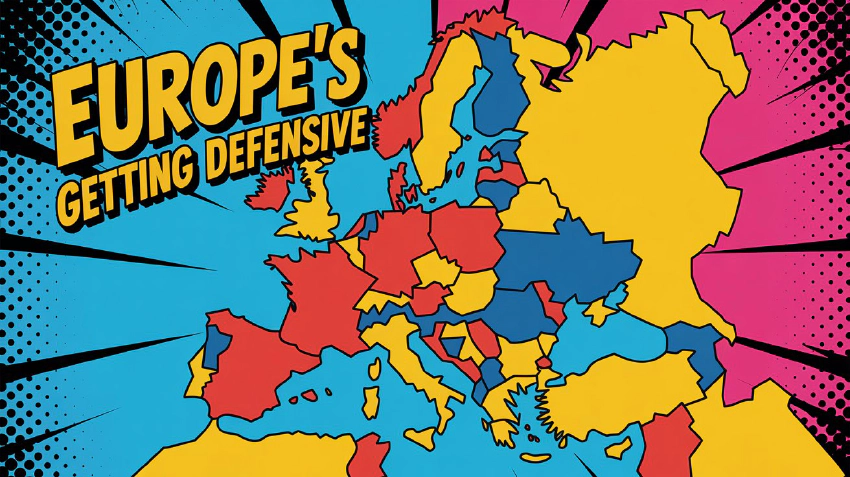
Europe's Getting Defensive
Nothing concentrates the mind quite like an existential threat to your sovereignty.
When President Trump stood before the World Economic Forum in Davos last week demanding Greenland—after threatening 25% tariffs on eight NATO allies unless Denmark cooperated—European leaders finally got the message they’ve been ignoring for decades: America’s security umbrella has terms and conditions. And those terms just changed.
The spectacle was remarkable. Trump demanded “complete and total control” of Greenland, threatened military allies with tariffs, and casually questioned whether NATO still serves American interests. French President Emmanuel Macron called the tariff threats “fundamentally unacceptable, even more so when they are used as leverage against territorial sovereignty.” Eight European nations issued a joint statement standing in “full solidarity” with Denmark.
But here’s what matters for investors: the damage is done. Even after Trump walked back the immediate tariff threats, European leaders aren’t forgetting this lesson. The message landed loud and clear—Europe can no longer outsource its security to an unreliable partner across the Atlantic.
And when sovereign nations realize they’re on their own? They spend. A lot.
The Numbers Don’t Lie
Strip away the diplomatic niceties and look at what European leaders are actually doing with their budgets. The shift is already underway:
- EU defense spending hit €343 billion in 2024, projected to increase by another €100 billion by 2027
- Defense investments surged 42% in 2024 compared to 2023, reaching a record €106 billion
- Germany alone plans to boost defense spending from 2.1% to 3.5% of GDP by 2029—over €150 billion annually
- NATO members agreed to a 5% GDP defense target by 2035 (up from the previous 2% target most countries ignored for years)
Let’s put those numbers in context. Germany increasing defense spending to 3.5% of GDP represents a fundamental reorientation of Europe’s largest economy. To put €150 billion in perspective: that’s more than the €100 billion Germany allocated to its entire climate and transformation fund over multiple years. Defense spending is about to dwarf climate spending—in Germany, of all places. For decades, Germany kept defense spending deliberately low—around 1.2-1.5% of GDP—as part of its post-WWII pacifist identity.
This isn’t tinkering at the margins. This is a structural shift.
NATO Secretary-General Mark Rutte, speaking at Davos, praised Trump for forcing European allies to “really grow up in the post-Cold War world.” Translation: Europe has been freeloading on American defense spending for three decades and just got kicked off the ride.
Follow the Money (It’s Going to European Contractors)
Where do you think those billions are going? Not to American contractors. Not anymore.
After Trump’s Greenland stunt and years of transactional “America First” foreign policy, European leaders are learning a painful but valuable lesson: strategic autonomy means building your own capabilities. You can’t threaten to seize an ally’s territory and expect them to buy your weapons the next day.
Take Rheinmetall. The German artillery manufacturer that most investors had never heard of just signed a €3.1 billion contract with the Bundeswehr. Five years ago, Germany’s government was debating whether defense contractors were morally acceptable investments. Now they’re writing billion-euro checks.
The other beneficiaries read like a roll call of European industrial power:
- BAE Systems (UK) - Europe’s largest defense contractor
- Thales SA (France) - £250 million Royal Navy contract
- Leonardo SpA (Italy) - Major aerospace and defense player
- Saab AB (Sweden) - Growing Nordic order book
The market is already pricing this in. The STOXX Europe Total Market Aerospace & Defense Index gained over 65% through 2025. A Goldman Sachs-tracked basket of European defense stocks climbed 13% in a single week in early January 2026.
But here’s the thing about multi-year defense buildups: they’re not speculative. These aren’t AI companies promising revolutionary technology five years from now. These are established manufacturers with government contracts already signed, delivering artillery shells, fighter jets, and missile systems that European nations now realize they desperately need.
The European defense industry generated €183.4 billion in turnover in 2024, a 13.8% increase from the previous year. And that was before the Greenland crisis fully crystallized the new reality.
Interesting. So How Do I Make Money From This?
For European defense exposure, you essentially have two high-liquidity options:
Option 1: EUDF (WisdomTree Europe Defence UCITS ETF)
For EUR investors or those comfortable with currency exposure:
- AUM: €4.1 billion (largest European defense ETF)
- Expense Ratio: 0.40%
- Holdings: 25 companies
- Top Holdings: Thales (12.5%), BAE Systems (11.6%), Rheinmetall (11.0%), Safran (8.3%), Leonardo (8.3%)
This is the pure play. Launched in March 2025, EUDF focuses exclusively on European companies engaged in military and defense. The fund is large enough to have genuine liquidity, fees are reasonable, and the holdings are concentrated in the exact contractors benefiting from increased European defense budgets.
Option 2: EUAD (Select STOXX Europe Aerospace & Defense ETF)
For USD investors who want to avoid currency risk:
- AUM: $1.43 billion
- Expense Ratio: 0.50%
- Domicile: United States
- Trades on: Cboe BZX Exchange
EUAD offers similar exposure but is USD-denominated and US-domiciled, making it easier for American investors to access. The slightly higher expense ratio (0.50% vs 0.40%) is the trade-off for USD denomination and US tax treatment.
The key difference: EUAD includes broader aerospace exposure, which dilutes the pure defense thesis somewhat. But if you’re dollar-based and don’t want to deal with EUR currency fluctuations, it’s a solid option.
The bottom line: If you’re EUR-based or don’t mind currency exposure, EUDF is the obvious choice—lower fees, bigger fund, purer defense focus. If you’re USD-based and want to avoid FX headaches, EUAD works despite the fee premium.
The Contrarian Case Against This Trade
Let’s acknowledge the bear case, because pretending risks don’t exist is how investors get blindsided.
The peace breaks out problem: What if tensions ease? What if Trump’s second term is less chaotic than his first? What if European leaders decide they overreacted? Defense stocks would likely pull back from current elevated levels.
Valuation risk: After last year’s surge, European defense stocks aren’t exactly undiscovered value plays. You’re not getting in on the ground floor—you’re buying after the elevator has already gone up several floors.
Execution risk: Government contracts are notorious for delays, cost overruns, and political interference. Just because Germany plans to spend €150 billion doesn’t mean Rheinmetall automatically converts that into shareholder returns.
The American contractor wildcard: European governments might still buy American equipment despite political tensions. After all, the F-35 remains the most advanced fighter jet in the world. Political rhetoric is one thing; military capability is another.
Here’s what matters: even if tensions ease tomorrow, European leaders have already learned they can’t rely on American security guarantees. That lesson doesn’t get unlearned when a new president takes office in 2029. The structural shift toward European defense independence is multi-decade, not multi-quarter. You can’t un-ring this bell.
What Makes This Different
Most investment themes I write about involve some degree of uncertainty about the future. Will AI live up to the hype? Will the Fed pivot? Will this sector come back into favor?
European defense spending is different. The money is already allocated. Germany’s €150 billion annual defense budget isn’t a maybe—it’s locked into fiscal planning through 2029. NATO’s 5% GDP target isn’t aspirational—it’s a commitment made by heads of state.
The question isn’t whether European defense spending will increase. It’s which contractors capture the most value and what valuation you’re willing to pay.
Right now, after a strong 2025 rally, you’re not buying at a discount. But you’re also not speculating on hypothetical future demand. You’re buying into a multi-year trend with contractual visibility and government backing.
In a market filled with speculative narratives, that’s a rare thing.
Here’s What I’m Watching
I’m not rushing to buy European defense ETFs at current valuations. But I am watching this closely for entry points.
Specifically, I’m looking for:
- Pullbacks on geopolitical de-escalation headlines - If Trump and European leaders have a warm photo-op and markets interpret it as “crisis over,” defense stocks will likely pull back. That’s when I’d consider building a position.
- Quarterly earnings from major contractors - I want to see whether Rheinmetall, BAE, and Thales are actually converting government commitments into revenue growth. Talk is cheap; executed contracts aren’t.
- German fiscal policy signals - Germany’s constitutional debt brake has historically limited defense spending. If Berlin creates a special fund or constitutional exemption for defense (which they’re discussing), that’s a bullish catalyst.
- Valuation relative to historical norms - European defense contractors historically traded at lower multiples than US peers. If the rally continues and valuations stretch beyond reasonable bounds, I’ll wait.
This isn’t a “buy at any price” situation. But it’s a structural trend I want exposure to at the right valuation.
Mission Accomplished (Just Not How Trump Planned)
Trump’s Greenland demands—absurd as they sounded—just accelerated a trend that was already underway. Europe was already increasing defense spending in response to Russia’s invasion of Ukraine. But Trump’s willingness to threaten military allies with tariffs over territorial demands crystallized something deeper: American security commitments are transactional, not ironclad.
The cruel irony? Trump’s stated goal was to force European NATO members to spend more on defense. Mission accomplished. They’re spending—just not on American equipment, and not out of gratitude for American protection.
They’re spending because they realize they’re on their own. That’s bound to make anyone defensive.