Inherited Problems
A friend in Hong Kong messaged me recently with what seemed like a simple question. He holds US stocks and US-listed funds through a Hong Kong broker. Nothing exotic, just the usual suspects. His question: “If I die, does the US government take a cut of these?”
I almost answered no. Then I actually looked it up. The answer is yes, and the size of the cut should worry every non-American who owns anything US-domiciled: stocks, ETFs, mutual funds, even money market funds.
Worse, when I ran the same audit on my own portfolio, I found the same exposure. IBIT. URNM. NUKZ. VXUS. PPLT. And those were just the headliners. All US-domiciled. All sitting in the blast radius. This article is about what I found, why it matters more than almost anything else in a non-US investor’s tax life, and the portfolio I’m rebuilding because of it.
The $60,000 Trap
Here’s the rule, and it’s brutal in its simplicity.
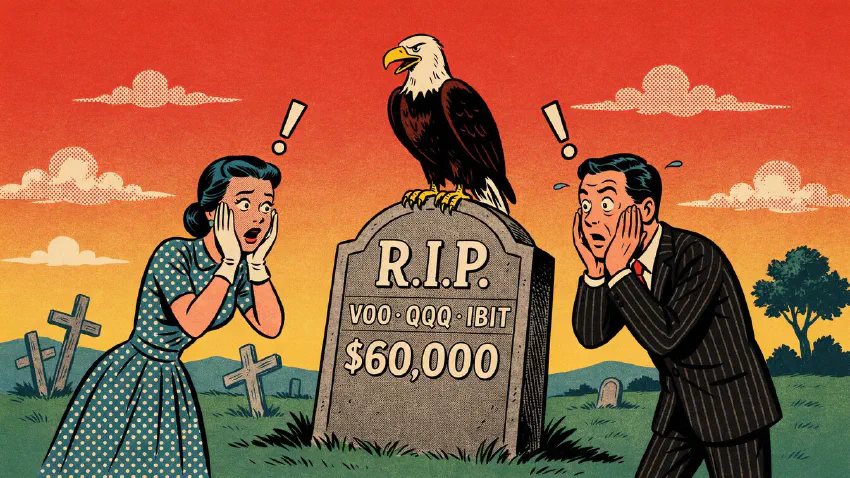
If you are not a US citizen or resident, and you die holding US-situs assets, the US levies estate tax on them at graduated rates from 18% up to 40%, above an exemption of just US$60,000. Not indexed for inflation. $60,000 flat, a figure that hasn’t moved since 1976. While Americans debate their multi-million-dollar exemptions, the non-resident number has sat frozen for half a century. When Washington reformed estate tax last year, it was debating somebody else’s exemption. Yours is still $60,000, and nobody is coming to raise it.
Neither Singapore nor Hong Kong has an estate tax treaty with the US, so there’s no relief. Do the arithmetic on a meaningful portfolio and the number gets ugly fast: a seven-figure US-situs portfolio faces a tax bill approaching 40% of everything above the threshold. That’s not a rounding error. It’s the single largest tax risk in most Singaporean and Hong Kong portfolios, and almost nobody talks about it because it only detonates once, at the worst possible moment, on the people you leave behind.
What Counts (And What Doesn’t)
The part that trips everyone up is situs: the legal location of the asset, not your broker, not your exchange, not you. The statute is blunt about what that means for stocks and funds:
“…shares of stock owned and held by a nonresident not a citizen of the United States shall be deemed property within the United States only if issued by a domestic corporation.”
Internal Revenue Code, §2104(a) (emphasis added)
Translate that from legalese and the rule of thumb writes itself: issued by a US company or US fund = US-situs = in the blast radius. Issued by anyone else = exempt, no matter which exchange you bought it on.
| US-situs (taxable above $60k) | NOT US-situs (exempt) |
|---|---|
| US-listed stocks (AAPL, MSFT) | Shares of non-US companies, even on US exchanges (Cameco on NYSE is Canadian, and exempt) |
| US-domiciled funds of any kind: ETFs and mutual funds (VOO, QQQ, IBIT, URNM), plus money market funds | UCITS ETFs (Irish/Luxembourg-domiciled; CSPX, VUAA, etc.) |
| US real estate | US Treasury bonds held directly (portfolio interest exclusion) |
| Tangible property physically in the US | Cash in US bank deposit accounts |
One row in that table deserves a second look, because it catches people who think they’re being careful: cash sitting in a US bank deposit is exempt, but the same cash swept into a US-domiciled money market fund is taxable. The label on the statement says “cash”. The law says “fund”.
The same trap hides inside your brokerage account. Idle cash held at a US broker is not a bank deposit; legally it’s a claim against the broker, and the IRS generally treats it as US-situs. The broker’s sweep program decides your fate: swept into an actual FDIC-insured bank, you’re probably exempt; swept into a money market fund, you definitely aren’t. The practical rule: don’t park large idle balances at a US brokerage. Hold the cash leg as Treasury bills bought directly: exempt, and yielding the same anyway.
Two traps deserve their own warning labels.
Your broker’s location is irrelevant. Holding US ETFs through a Singapore or Hong Kong broker does nothing. Situs follows the asset. And at death, brokers routinely freeze US-situs assets pending IRS transfer certificates, so your executor gets to navigate Form 706-NA while the account sits locked.
Cross-listings don’t launder domicile. SPDR Gold Shares trades on the SGX as O87. Same US trust, full exposure. The LSE carries US-domiciled funds on its international segment under odd 0xxx tickers. Buy one of those and you’ve bought a US asset regardless of the London postcode. Domicile follows the asset, not the venue.
The Fix Hiding in Plain Sight
Here’s the almost absurd part: the fix costs nothing and loses nothing.
Ireland-domiciled UCITS ETFs hold the identical underlying assets (CSPX holds the same S&P 500 stocks as VOO), but the fund itself is Irish, so your holding is a foreign asset. Zero US estate tax exposure. As a bonus, the Ireland-US tax treaty cuts dividend withholding inside the fund from 30% to 15%, a permanent yield edge that compounds quietly for decades. Direct US Treasuries are exempt anyway under the portfolio interest exclusion, so the world’s safest asset remains fully available.
Same assets. Same liquidity. No ticking time bomb. Once you see it, holding the US-domiciled versions becomes indefensible.
First, What Is UCITS?
UCITS stands for Undertakings for Collective Investment in Transferable Securities, a European regulatory framework for investment funds. The acronym is forgettable; the address is what matters. UCITS funds are domiciled in Europe, mostly Ireland and Luxembourg, under strict investor-protection rules, and a fund domiciled in Ireland is a foreign asset under US tax law. That makes it the escape hatch from everything described above.
They’re also easy to buy. The big UCITS ETFs trade on the London Stock Exchange and across Europe in USD, GBP and EUR lines, so purchasing them from Singapore or Hong Kong is no harder than buying the US versions. Same fund houses you’ll recognize, same indices, different flag on the wrapper.
The World as It Is
Which forced the real question. If I were going to strip every US-situs asset out of my portfolio, what should the portfolio actually be?
The answer starts with the world as it is in September 2026. The Fed, now chaired by Kevin Warsh, just delivered its first rate hike since 2023, taking Fed funds to 3.75-4.00%, with the dot plot promising one more. The 10-year Treasury yield is back above 5%, a level not sustained since 2007. CPI is stuck at 3.4%, PPI is running above 5%, Oil is over $105 with an active Middle East conflict, and the S&P 500 sits near record highs anyway. Stocks and yields rising together is historically the least stable configuration markets produce.
Oaktree has been saying it plainly, citing J.P. Morgan data: when investors bought the S&P at a 23x forward multiple, long-term returns landed between +2% and -2% annualized. Adjusted for 3% inflation, that’s a decade of going backwards in real terms. Howard Marks makes the same argument in sixty seconds:
My view, stated with all appropriate humility: the era of US exceptionalism is in its late innings. Deficits will keep growing. Some form of monetary debasement is coming. Capital that has starved regional exchanges for fifteen years will rotate home. And AI, revolutionary as it is, will not deliver the productivity miracle currently priced into ten stocks carrying 40% of the index. I could be wrong. I’ve sized the portfolio so that being wrong is survivable.
The Portfolio
This is a transparent account of what I am building toward, percentages only, because the dollar figure is irrelevant to the logic. It’s my answer to the problem, not a model for yours.
Some honesty before the table: I have not achieved this portfolio. It’s the destination, not my current location, and getting there is a journey of weeks or months, not a weekday. I still hold legacy names from the old book: Yancoal (HKEX:3668), the Hang Seng Tech ETF (HKEX:3067), Cocoa (COCO), Rhodium (XRH0), Nam Cheong (SGX:1MZ), and several others. None of them are US-situs problems, which is exactly why they can stay until the price is right; I’ll sell them at opportune moments.
I’ll also keep trading individual non-US names when market conditions hand me the setup: the core stays boring, the edges stay interesting. Which shapes the table too: most readers want simple ETF-based instruments, not a part-time job managing twenty-plus positions, so what you see is the core I’m working toward, with the individual names on the periphery.
| Sleeve | Weight | Instrument | Exchange | Function |
|---|---|---|---|---|
| World ex-US | 10% | EXUS (Xtrackers MSCI World ex USA) | LSE | The rotation trade in one line: 780+ non-US companies at ~18x earnings versus ~23x for the S&P |
| US equal weight | 5% | XDEW (Xtrackers S&P 500 Equal Weight) | LSE | My hedge against being wrong about America: the other 490 US companies at ~20x, without the megacap concentration |
| Emerging Asia | 7.5% | EMIM (iShares Core MSCI EM IMI) | LSE | China, India, Taiwan, Korea: the markets global capital abandoned |
| Japan | 10% | 1475 (iShares Core TOPIX) | TSE | Governance reform, BOJ normalization, and the yen as a free crisis hedge |
| Singapore banks | 15% | DBS / UOB / OCBC | SGX | ~5% dividend yields, inflation beneficiaries, and SGD-denominated ballast against my SGD-denominated life |
| Energy | 7.5% | XDW0 (Xtrackers MSCI World Energy) | LSE | Oil majors priced off $105 Brent, not off the S&P’s multiple |
| Broad commodities | 5% | CMOD (Invesco Bloomberg Commodity) | LSE | Agriculture, metals, energy: the diesel cost-push flowing through everything |
| Uranium | 5% | U.U + CCJ | TSX / NYSE | The metal and the best house in the sector. A structural shortage that needs no AI narrative: Kazatomprom is cutting production, spot is $90/lb, and reactors buy on multi-year contracts regardless |
| Gold | 10% | IGLN (iShares Physical Gold ETC) | LSE | The debasement hedge. Central banks bought 289 tonnes in Q2 alone, and they bought into price weakness. That’s an official-sector floor under the metal |
| Bitcoin | 5% | 9042 (ChinaAMC Bitcoin ETF, USD counter) | HKEX | Debasement convexity, Hong Kong-domiciled so it stays out of the estate tax bucket, unlike the IBIT it’s replacing |
| Long US Treasuries | 15% | Direct 10Y + 30Y bonds | Direct | The recession fighter. Held directly, Treasuries are estate-tax exempt, and if the Fed breaks something, duration is the one asset that pays when everything else bleeds |
| Cash / T-bills | 5% | IB01 (iShares $ Treasury 0-1yr) | LSE | Dry powder. Bills yield near 4% and the long end pays over 5%: cash is finally an asset class again |
What the Reshuffle Bought (and Cost)
A few things worth noticing about what’s not here. URNM and NUKZ are on the way out, both US-domiciled, both duplicative of Uranium exposure I hold directly. If you want the whole Uranium basket rather than my two names, URNM exists in a UCITS wrapper on the LSE (ticker URNU): same miners index, Irish-domiciled, no situs problem. IBIT is going the same way, with the Hong Kong spot ETF taking its place: same underlying Bitcoin, no US situs. VXUS and PPLT round out the departures: the ex-US equity job moves to EXUS, and the Platinum punt was a trade, not a pillar. The destination book contains not a single US-situs asset: the estate tax exposure is zero, not merely managed.
The reshuffle came with gains beyond the tax fix. The portfolio got simpler: twelve line items, most of them one-fund sleeves, replacing a sprawl of overlapping positions I had to babysit. And the whole book now trades on my clock. SGX, Hong Kong and Tokyo run through my morning and afternoon, and the LSE opens at 3pm Singapore time and runs to half past eleven at night (4pm to half past midnight in the European winter). I can manage every position in this portfolio between breakfast and dinner, and the 9:30pm New York open no longer gets a vote on my sleep schedule. My heirs also inherit a cleaner process: no frozen brokerage account, no Form 706-NA, no IRS transfer certificate standing between them and the assets.
The costs are honest ones. I’m giving up the individual US names: no Amazon, no single-stock punts on the NYSE, because any US company’s shares are US-situs by definition. (A capped exception under $60k is possible; I decided simple beats clever.) A few themes still have no UCITS wrapper at all (Coal is one; no European-listed fund tracks it), and some of the equivalents that do exist are younger and smaller than the American originals. And the European funds charge a few basis points more than the American giants and trade a little thinner, though at retail size both differences are rounding errors.
Two names sit on the watchlist all the same. DFNS, the VanEck Defense UCITS ETF on the LSE, covers the global rearmament theme in an Irish wrapper. NUCL, VanEck’s Uranium and Nuclear Technologies UCITS ETF, is the closest thing to a UCITS NUKZ: the whole nuclear ecosystem, utilities and reactor tech included, not just the miners. Neither is in the book today. Both are there if I want those themes back without re-opening the situs door, and it’s nice to have options.
What Could Go Wrong
Intellectual honesty requires stating the obvious: this is one macro view wearing a dozen costumes. Strip the labels and it’s roughly three-quarters long “Asia and real assets, short US exceptionalism.” If the S&P does +18% next year (and it might; expensive markets stay expensive for years), this portfolio will feel stupid. It won’t be stupid. But it will feel it, and that gap is where portfolios like this die.
The other honest caveat: in a true deflationary accident, almost everything here falls together, and the book leans hard on its 20% defense. I’ve sized that defense with the aim of holding a bad year to the mid-teens. If that number makes you flinch, the correct response is more cash and bonds, not fewer opinions.
Your Monday Morning
If this article just raised a question about your own account, the audit takes ten minutes:
- Check the ISIN, not the exchange. Every fund and stock has one, on the fact sheet or your broker’s security page. Starts with
US: US-situs, exposed. Starts withIE(Ireland) orLU(Luxembourg): exempt. The venue you bought it on changes nothing. - Add up the US-situs total and compare it to US$60,000. That is the exemption, and everything above it faces up to 40% at death. Individual US stocks count too, not just funds.
- If the number bothers you, the swaps are usually one-for-one. VOO becomes VUAA or CSPX. QQQ becomes EQQQ. IBIT becomes 9042 in Hong Kong. Same index or same asset, different flag on the wrapper.
- Confirm your broker’s access first. LSE access at Singapore and Hong Kong brokers varies on commissions, FX spreads and custody fees, and the Hong Kong Bitcoin ETFs need HK market access. Ten minutes with the fee schedule beats discovering it mid-trade.
Death and Taxes
Back to my friend’s question. The US tax code gives non-resident investors a choice that isn’t really a choice: hold US stocks and the world’s most popular funds in wrappers that hand up to 40% of them to a foreign government when you die, or hold the identical assets in wrappers that don’t. Same stocks. Same bonds. Same Gold. Same Bitcoin. The only difference is which legal entity’s name is on the tin.
They say nothing is certain except death and taxes. The trick, it turns out, is making sure they don’t arrive at the same time.
This is a personal account of my own positioning and research, not financial advice. Tax rules are complex and individual circumstances vary, so if this article raised questions about your own exposure, that’s your cue to speak to a qualified cross-border tax adviser. Which, to state the obvious, I am not.