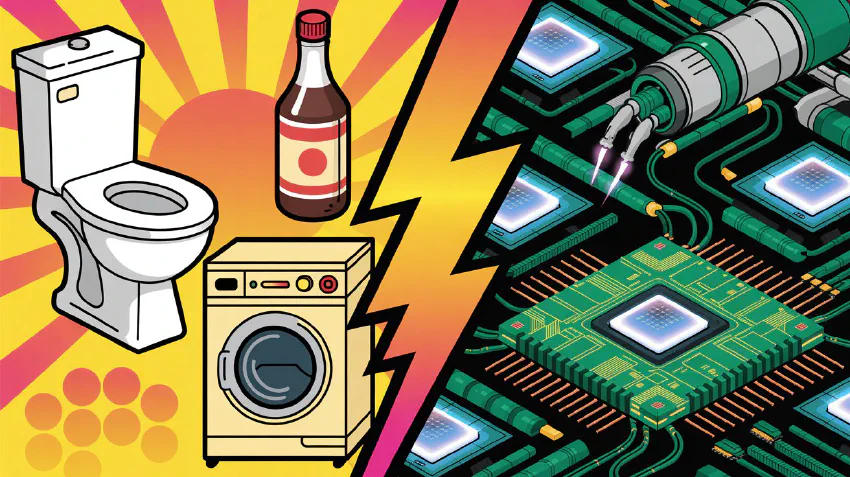
Made in Japan
Apple didn’t call Nvidia. Apple called Tokyo.
Specifically, Apple lobbied Japanese government officials to help secure more supply from a 107-year-old company most investors have never heard of. Not for chips. Not for software. For glass cloth — a specialty material so critical to AI chip manufacturing that the world’s most valuable company couldn’t get enough of it through normal channels.
That single anecdote tells you more about the AI supply chain than a hundred Nvidia earnings calls.
All Roads Lead Here
Pick your AI winner. Nvidia or AMD. TSMC or Samsung. OpenAI or Anthropic. Microsoft or Google. It doesn’t matter. Every path through the AI supply chain runs through the same handful of Japanese factories.
These aren’t optional components. There is no substitute. No alternative route exists. The road doesn’t fork around them — it runs through them.
While Western investors crowded into the obvious plays — the chip designers, the hyperscalers, the infrastructure names commanding premium valuations — a small group of Japanese specialty manufacturers quietly became the irreplaceable foundation of the entire AI buildout. Priced like industrials. Operating like monopolies.
That gap between what the market thinks these companies are and what they actually are is where the opportunity lives.
You Know These Companies. Just Not For This.
TOTO (TSE: 5332)
Japan’s most famous toilet manufacturer. Precision bathroom ceramics since 1917. The company that taught the world what a washlet was.
What most investors don’t know: since the 1980s, TOTO has manufactured electrostatic chucks — the ceramic components that hold silicon wafers perfectly flat and thermally stable inside semiconductor fabrication equipment during plasma etching and deposition. It takes over 4,000 steps to process a wafer. Many of those steps require precise wafer positioning. TOTO’s ceramics are there for all of them.
The capability that produces a perfectly uniform ceramic toilet bowl — controlled firing, precise material composition, uniform thermal properties — is the same underlying expertise that semiconductor equipment manufacturers need in a component that cannot fail. TOTO didn’t reinvent itself. It applied a century of precision ceramics knowledge to a problem nobody else could solve as well.
The numbers reflect the shift. TOTO’s semiconductor ceramics division now generates ¥28.9 billion in operating profit at a nearly 40% margin — contributing over 40% of the company’s total operating income. Goldman Sachs upgraded the stock to buy in early 2026, citing a tight supply-demand environment in memory as a structural tailwind. The company is expanding into downstream packaging steps including cutting and 3D chip stacking, chasing the next wave of complexity in semiconductor manufacturing.
The housing business still shows up in the revenue line. The ceramics business is increasingly the earnings story.
Ajinomoto (TSE: 2802)
Known globally for MSG and umami seasoning. A food company with a presence in supermarkets across Southeast Asia, Europe, and the Americas.
What most investors don’t know: Ajinomoto controls roughly 50% of the global market for ABF — Ajinomoto Build-up Film — the insulating layer used in semiconductor package substrates. ABF is inside every high-end Nvidia GPU. Every AMD processor. Every AI accelerator running in every data center being built right now. Without ABF there is no substrate. Without a substrate there is no chip.
The connection isn’t coincidental. The precise chemical processing required for food-grade amino acid production at industrial scale demands exactly the kind of materials science capability needed to produce ABF film at the tolerances advanced chip packaging requires. Different product, same underlying expertise.
The ABF business is generating ¥100.7 billion in annual sales — up 31% year on year — with operating margins exceeding 50%. It now accounts for 30% of Ajinomoto’s total operating profit. With demand continuing to outpace supply, ABF film prices have been moving sharply higher — spot prices up more than 30%, with broader contract prices expected to follow. Morgan Stanley forecasts a significant ABF shortage by 2027. Goldman Sachs projects a 33% compound annual demand growth rate from 2025 to 2028, driven by AI GPU and ASIC substrates growing two to four times in size within two years.
A food company with a 50% margin semiconductor materials monopoly. The market hasn’t fully decided which it is.
The Names You’ve Never Heard Of
Nittobo — Nitto Boseki Co., Ltd. (TSE: 3110)
A 107-year-old Japanese company that started as a textile maker and now controls approximately 90% of the global market for low-coefficient of thermal expansion glass cloth — the critical insulating layer in semiconductor package substrates that prevents chips from warping as they heat up.
The connection to textiles isn’t incidental — glass cloth is literally a textile product. It is glass fiber strands woven into fabric. The precision weaving, fiber diameter control, and surface chemistry that Nittobo spent a century perfecting for industrial textile manufacturing translate directly to the exacting tolerances semiconductor-grade glass cloth requires. Same expertise, different material. The same story as TOTO and Ajinomoto, just less obvious from the outside.
Low-CTE glass cloth is a key ingredient in copper-clad laminates, the base substrate of every printed circuit board used in AI servers. As chips get bigger and more powerful, thermal expansion becomes a more acute engineering problem. Nittobo’s glass is the solution the industry keeps coming back to.
Nvidia, AMD, Qualcomm, Broadcom, and TSMC all depend on it. So does Apple — which went to the Japanese government when normal procurement channels weren’t delivering enough. The CEO has said publicly that the surge in orders has been so overwhelming the company cannot guarantee it will fulfill everything.
Nittobo is now developing a next-generation T-glass with a 30% improvement in thermal expansion coefficient, targeting 2028 commercial rollout, while simultaneously developing low-dielectric glass cloth for AI server networking equipment. The moat isn’t just the current product. It’s a research pipeline that keeps moving up the performance curve before competitors can close the gap.
Rigaku Holdings (TSE: 268A)
X-ray measurement and inspection equipment. Founded in 1951 with roots in scientific instrumentation for healthcare and materials research. Not a name that appears in any mainstream AI narrative.
What Rigaku actually is: a producer of X-ray metrology systems used to detect defects at atomic scale in semiconductor manufacturing. At leading-edge nodes — 3nm, 2nm and below — a single missed defect in a wafer stack costs millions in scrapped output. As chip architectures become more complex, as chiplet designs multiply, as 3D stacking and CoWoS packaging become standard, the inspection requirements become more demanding. X-ray is the only technique that can see inside a fully packaged stack without destroying it.
Rigaku’s semiconductor division is growing at over 20% annually with gross margins around 60% and operating margins near 30%. For a hardware company, those are software economics.
The external validation arrived in early 2026. Onto Innovation — a US-listed semiconductor equipment company — agreed to acquire a 27% stake in Rigaku Holdings for $710 million, targeting at least $300 million in incremental market opportunity by 2030 through combined X-ray and optical metrology offerings. A sophisticated peer paying $710 million for a minority stake is about as clear a signal as capital markets produce. Rigaku now has distribution access into Onto’s existing customer base at TSMC, Samsung, Micron, and Intel.
Nippon Electric Glass (TSE: 5214)
A direct competitor to Nittobo in the specialty glass substrate space, with its own growing position in low-CTE and low-dielectric glass cloth for semiconductor packaging. Less dominant than Nittobo in the premium tier but expanding aggressively as AI demand creates room for more than one supplier. Carries a meaningful dividend yield — unusual for a company with this kind of structural growth tailwind.
Asahi Kasei (TSE: 3407)
A Japanese conglomerate the market prices as a housing and chemicals business. The reality is more interesting. Asahi Kasei is one of two primary global players in low-dielectric glass cloth — a critical material for high-speed signal transmission in AI server networking equipment. It is also developing quartz cloth, a next-generation substrate material that outperforms glass on signal transmission and could define the following wave of semiconductor packaging requirements. The semiconductor materials business is growing faster than the rest of the company and carries significantly higher margins. The conglomerate discount is real. Whether it’s justified is a different question.
The Name Most Investors Know. But For The Wrong Version.
Hitachi (TSE: 6501)
The Hitachi that sold washing machines and air conditioners is being systematically dismantled. The overseas appliance unit was sold to Turkey’s Arcelik. The Japanese home appliance business is going to Nojima for ¥110 billion. The consumer electronics brand that defined Hitachi’s public image for decades is gone or going.
What’s replacing it: Lumada, Hitachi’s AI-powered industrial platform, now representing 40% of total consolidated revenue and growing toward 50%. And Hitachi Energy — the world’s largest transformer manufacturer — sitting on a ¥10 trillion order backlog as every AI data center being built right now needs grid infrastructure that will take a decade to construct.
The reason Lumada matters isn’t that Hitachi built an AI platform. It’s what the platform runs on. Hitachi has spent decades embedded in the operational infrastructure of railways, power grids, water systems, and factories across Japan, Europe, and Southeast Asia. That isn’t just customer relationships — it’s proprietary operational data, engineering process knowledge, and institutional credibility that no software company starting from scratch can replicate. When Hitachi sells Lumada into a rail operator or an energy utility, it’s selling AI built on top of domain expertise that took half a century to accumulate.
The monetisation model reflects this. HMAX — the recurring AI service suite within Lumada — reached ¥300 billion in revenue with EBITDA margins exceeding 20%. Hitachi is converting long-standing hardware and systems relationships into recurring software subscriptions across exactly the sectors where AI adoption is structurally inevitable: predictive maintenance, grid optimisation, industrial automation, transport management. The customers already trust Hitachi. The transition from hardware vendor to platform subscription is already underway — and subscription revenue in industries with decade-long procurement cycles is about as sticky as revenue gets.
One company. Two structural growth businesses. Neither makes appliances.
The Pricing Power Paradox
There is a legitimate risk worth naming. Japanese corporate culture is historically reluctant to raise prices on customers. The relationship comes first. Margins absorb pressure before contracts get repriced. This is real, deeply embedded, and has hurt Japanese suppliers caught between rising input costs and the cultural reluctance to pass them through.
This group of companies faces that dynamic differently.
When your product represents 0.1% of the final chip cost but its absence makes the chip impossible to produce, the normal supplier-customer dynamic inverts. Doubling the price of Nittobo’s glass cloth has zero economic impact on the cost of an H100 GPU. But without that glass cloth, there is no H100. That is irreplaceable input with perfectly inelastic demand.
Ajinomoto has been raising ABF prices as supply tightens. The impact on overall substrate costs: 3 to 6%. The impact on Nvidia’s unit economics: a rounding error. The pricing power isn’t theoretical — it’s being exercised, and customers are accepting it because the alternative is no allocation at all.
Even Japanese cultural conservatism eventually yields to a market where you control 90% of global supply of something the most powerful technology companies in the world cannot work without.
The Risks Worth Naming
The pricing power argument is real. The moats are real. The opportunity is real. None of that means the risks aren’t.
Yen sensitivity. These companies report in yen. International investors are implicitly long the currency. A strengthening yen compresses margins on dollar-denominated export revenues; a weakening yen inflates headline numbers while eroding returns in USD or SGD terms. Currency is rarely the thesis, but it’s always in the trade.
Geopolitical exposure. Japan has broadly followed US semiconductor export restrictions. The supply chain these companies feed runs through TSMC, Samsung, and Intel fabs operating in a geopolitically complex environment. Any structural slowdown in the global AI buildout — whether from export controls, US-China escalation, or demand disappointment — flows through. These companies don’t pick sides. They also don’t get to opt out.
Partial rerating already in. These are not unknown stocks. Nittobo, Ajinomoto’s ABF division, and Rigaku have all received meaningful institutional attention in the past 18 months. The valuation discount is real, but it’s narrower than it was. Buying now requires the growth trajectory to keep delivering — not just the story to be discovered.
The Valuation Case
Nvidia currently trades at roughly 43 times trailing earnings. That’s the honest benchmark — the most visible AI name in the world, priced accordingly. Not all of these names are cheap by comparison. Some aren’t cheap at all.
| Company | Trailing P/E |
|---|---|
| Asahi Kasei (3407) | 12–13x |
| Nippon Electric Glass (5214) | ~19x |
| Nittobo (3110) | ~22x* |
| TOTO (5332) | ~26x |
| Hitachi (6501) | 27–29x |
| Ajinomoto (2802) | ~41x |
| Rigaku (268A) | 47–53x |
*Normalised. A one-time asset sale distorted the headline figure, producing a misleading 59% net profit decline that triggered a sharp selloff from investors who read the number without reading the footnote. The underlying business: revenue growing 16%, operating profit growing 25%, EBITDA margins expanding to 27%.
The valuation case is strongest where the perception gap is widest. Asahi Kasei at 12–13 times is priced as a housing and chemicals conglomerate. The semiconductor materials business embedded inside it — low-dielectric glass cloth, quartz cloth development, aggressive capacity expansion — carries margins that don’t belong in that category. Nippon Electric Glass at 19 times with a dividend yield is a structural growth story the market still hasn’t fully labelled. TOTO at 26 times looks reasonable until you account for the housing business drag — the ceramics division carrying 40% of operating income is doing heavy lifting at an implicit premium. Activist investor Palliser Capital has taken a stake arguing for 55% further upside through ceramics expansion.
Hitachi at 27–29 times is fair value for a ¥10 trillion energy order backlog and an industrial AI platform growing toward half of revenues.
Ajinomoto at 41 times is expensive for a food company. Defensible for a semiconductor materials monopoly generating 50% operating margins on its fastest-growing segment, raising prices into a confirmed shortage. Whether you believe that is a judgement call — but the business quality isn’t in question.
Rigaku at 47–53 times requires the growth trajectory to keep delivering. A sophisticated peer just paid $710 million for a 27% stake. That’s endorsement, not guarantee. Eyes open.
Five of these names are priced well below Nvidia despite supplying the same supply chain. Two trade at parity or above. Know which category you’re buying before you buy it.
The Road Less Travelled, Where All Roads Lead
Most investors chasing the AI theme are buying the obvious names. Chip designers. Hyperscalers. US semiconductor equipment companies. Fine businesses. Extensively covered, widely owned, and priced accordingly.
The companies described here operate in a different part of the map. Western institutional coverage is thin. The names conjure toilets and seasoning, not GPU supply chains. That invisibility is not a reflection of strategic irrelevance. It is the source of the valuation gap.
Strip away the brand associations and what remains is a group of near-monopolies in materials and equipment that every AI chip manufacturer needs, regardless of who wins the AI race. They do not pick winners. They supply all of them. That is a fundamentally different risk profile from owning any single AI company — and a more durable one.
The AI revolution, wherever it leads, is being built on components made in Japan.
Apple already knew. That’s why they called Tokyo.