Two Bulls in a China Shop
There’s an old saying in poker: the most dangerous player at the table isn’t the best one. It’s the one who doesn’t know the rules.
Donald Trump has built a career on being the agent of chaos. Walk into a negotiation, flip the table, let the other side scramble for stability while you dictate terms. It worked on the European Union. It worked on Canada. It worked on China — to a degree. The playbook is simple: be unpredictable against a predictable opponent, and unpredictability wins every time.
Then he walked into the room with Iran.
And for the first time, the agent of chaos met another agent of chaos. A regime that has survived 45 years of sanctions, a brutal eight-year war with Iraq, the assassination of its most celebrated general, waves of domestic protest, and the systematic dismantling of its regional proxy network. A regime that doesn’t need stability. A regime that, in many ways, feeds on chaos.
Trump apparently didn’t get the memo.
The Venezuela Playbook Doesn’t Work Here
After the swift success in Venezuela — a soft target with no meaningful military capability, no ability to threaten global shipping, and no ballistic missiles that can reach Diego Garcia — Trump seems to have drawn a dangerously wrong conclusion: that the same playbook scales.
It doesn’t.
Venezuela folded because it had no cards. Iran has been dealt into this game for decades and has been waiting for someone to go all-in. The moment the US-Israeli strikes began on February 28, Iran didn’t scramble for the exits. It escalated. Missiles into Israel, drones into Gulf energy infrastructure, the Strait of Hormuz effectively closed, a ballistic missile targeting Diego Garcia — 2,500 miles from Tehran — demonstrating a reach that surprised even the Pentagon. And when Trump threatened to “hit and obliterate” Iranian power plants if the Strait wasn’t reopened within 48 hours, Iran’s response was immediate: all US energy infrastructure in the region would be targeted.
This is not a regime looking for an off-ramp.
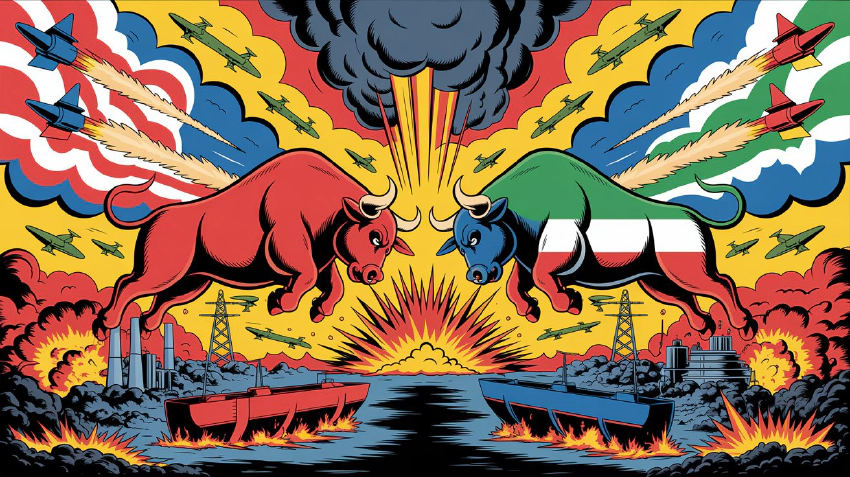
Here’s the honest assessment: I have no idea how this ends. Trump’s mixed signals — “winding down” on Friday, threatening power plants on Saturday — suggest a man improvising at the edge of a situation that has outgrown his playbook. The 48-hour ultimatum clock is ticking. Iran isn’t blinking. We have two bulls in a china shop, and every time one charges, the other charges back.
Strip away the geopolitical noise and one thing becomes clear: this is unknowable. And when something is unknowable, the smart move is to stop trying to predict it and start asking a different question entirely.
The Better Question
There’s a saying I keep coming back to:
It’s really hard to make money in the next five months, but it’s really easy to make money in the next five years.
The five-month view requires you to correctly predict: when the conflict ends, whether Trump follows through on his ultimatum, how Iran responds, whether the Strait reopens, what oil does, what the Fed does, and whether we tip into stagflation or recession. Get any one of those wrong and your trade is toast.
The five-year view requires you to correctly identify: which secular trends were already in motion before February 28, and whether any of them were actually impaired by the war.
That second question is far more answerable.
Because here’s what the market is doing right now. It’s selling everything. The S&P 500 is down roughly 5% from its January peak. The Russell 2000 has already crossed into correction territory — down more than 10%. The VIX has spiked above 27. Institutions are de-risking, algorithms are selling momentum, and retail investors are panicking into cash.
And in that indiscriminate panic, the market is doing something it always does in moments of fear: throwing the baby out with the bathwater.
High-quality assets with intact multi-year theses are being sold alongside oil majors and shipping companies — the only two categories where the Iran war actually has a logical fundamental impact. Everything else is collateral damage.
That collateral damage is the opportunity.
How I’m Thinking About Entry
Let me be clear about what I’m not doing. I’m not buying oil. I’m not chasing LNG. The time to have gotten into energy was when WTI was trading at $60 a barrel, not when it’s above $95 and moving on every Trump Truth Social post. When the oil trade is on the front page of every newspaper and your cab driver is asking about energy stocks, the strippers have already shown up to the party. You missed it.
I’m also not buying US LNG producers — even though the thesis is genuinely compelling. Qatar just lost 17% of its LNG export capacity for three to five years. Countries desperate to replace Qatari supply are signing decade-long contracts with US producers right now. The contract lock-in angle is real. The problem? The market already knows. Cheniere hit an all-time high last week. Venture Global is up 50% in a month. Cheniere is up 70% year-to-date. Those stocks aren’t babies thrown out with the bathwater — they are the bathwater. The smart version of this trade happened six months ago.
What I am doing is building a watchlist of assets that were trending strongly before February 28 and have since been marked down for reasons that have nothing to do with their actual business.
The entry framework is deliberate. I’m not buying the first 5% dip. That’s noise. I’m waiting for genuine dislocations — meaningful pullbacks where the price has moved but the thesis hasn’t. And when those levels arrive, I’m buying in tranches. One-third position at the 50-day EMA. Another third at the 200-day EMA. The final third at the 800-day EMA if it gets there. This approach removes the hubris of trying to call the exact bottom, and ensures I have dry powder if the situation gets worse before it gets better.
Now let me show you what I’m watching.
The Watchlist: Secular Trends the War Didn’t Touch
Robotics and Automation: BOTZ (Global X Robotics & AI ETF)
BOTZ was within pennies of its 52-week high on February 26 — up 66% over the prior year — before the war knocked it down nearly 15%.
Here’s what changed on February 28: absolutely nothing about the robotics thesis. Labor shortages haven’t reversed. Reshoring mandates haven’t been cancelled. The declining cost of AI compute hasn’t reversed. Factory automation demand from manufacturers bringing production back to the US is a policy-driven, demographically-driven, decade-long trend. The global robotics market is projected to grow from $108 billion today to $416 billion by 2035. NVIDIA — the top holding — just guided next quarter to $78 billion in revenue.
The Iran war didn’t touch any of that. The selloff is pure guilt by association — a high-momentum tech-adjacent name getting liquidated alongside everything else. BOTZ is the clearest baby-thrown-out-with-bathwater situation I can find right now.
Rare Earth Minerals: REMX (VanEck Rare Earth & Strategic Metals ETF)
This one has a delicious irony baked in. REMX was up 35% year-to-date by February 28 — the market pricing in US-China decoupling, critical mineral supply chain independence, and Trump’s executive orders pushing domestic rare earth development. When the war started, REMX actually spiked higher as supply chain fears flared, hitting $103. Then broader liquidation took over and it crashed 24% from peak.
Here’s the thing: the war didn’t weaken the rare earth thesis. It strengthened it. China controls 69% of global mining and over 90% of processing for the critical minerals that go into defense systems, EVs, and advanced electronics. Every new geopolitical shock — whether tariffs, Taiwan tensions, or a Middle Eastern war — adds another layer of urgency to building Western supply chain independence. REMX has been sold down because it ran hard and institutional desks needed to raise cash. The underlying story hasn’t changed one bit.
This is the highest-risk, highest-reward name on my list. Treat it accordingly.
Power Grid Infrastructure: GRID (First Trust NASDAQ Clean Edge Smart Grid ETF)
Here’s a cruel irony the market seems to have missed entirely. An energy supply shock caused by a war in the Middle East — the kind that sends Brent above $100 and briefly touching $119 — an 80% surge in three weeks — is actually the best possible advertisement for grid modernization and electrification independence. Every dollar oil rises above $100 makes the economic case for renewable generation, smart grid infrastructure, and energy storage more compelling.
And yet GRID is down nearly 10% from its peak.
US electricity demand is projected to grow 8% through 2029 — versus 0.4% annual growth over the prior two decades. AI data centers alone are expected to consume 11-15% of total US electricity by 2030. Annual grid investment needs are estimated at $100 billion. The top holdings — National Grid, ABB, Schneider Electric, Eaton — have multi-year order backlogs set by infrastructure contracts that no geopolitical event can cancel overnight.
Note for those already holding PAVE: this is not the same trade. PAVE is broad physical infrastructure — roads, bridges, steel. GRID is specifically electrical grid modernization. Minimal overlap. Different thesis. Both valid.
Water Infrastructure: FIW (First Trust Water ETF)
If you want the cleanest possible expression of “completely unrelated to the Iran conflict, sold off anyway,” this is it.
FIW tracks 36 US water companies — treatment systems, pipes, filtration, pumping equipment, utilities. It was up 27% over the trailing year before the war. It has since fallen 9%. The reason for the selloff: broad market panic. The connection to Iran: zero. Water utilities operate on municipal contracts set years in advance. The demand drivers — aging pipe networks over a century old, PFAS contamination remediation requirements, semiconductor fab water consumption, population growth in drought-stressed regions — exist entirely outside of anything happening in the Persian Gulf. The 2021 Bipartisan Infrastructure Law committed $55 billion specifically to water infrastructure. That money isn’t being cancelled because of a conflict in the Middle East.
This is the most boring pick on the list. I mean that as the highest possible compliment.
Biotech: XBI (SPDR S&P Biotech ETF)
The conventional wisdom says AI disrupts everything. SaaS companies are getting destroyed — why pay for software subscriptions when AI can replicate the function for a fraction of the cost? The “SaaSpocalypse” is real.
But biotech doesn’t work that way. AI isn’t replacing the drug — it’s finding it faster. AlphaFold collapsed protein structure prediction from years to hours. AI-powered clinical trial design is reducing failure rates. Drug discovery pipelines that used to take 12-15 years are being compressed to 7-8. For biotech, AI isn’t the competitor eating the margin. It’s the tailwind compressing the cost curve and shortening the path to revenue.
XBI returned 36% in 2025, hit a January peak of $132, and has since pulled back roughly 9% on zero fundamental news. Drug development timelines, FDA regulatory processes, and clinical trial pipelines have no sensitivity to the price of oil or the status of the Strait of Hormuz. The healthcare sector is trading at a 30% discount to the S&P 500 — the deepest de-rating in 35 years. That’s not a warning sign. That’s an invitation.
Semiconductors: SMH (VanEck Semiconductor ETF)
The AI infrastructure spending supercycle has a simple logic: hyperscalers have committed hundreds of billions through the end of the decade, the 2nm chip transition is underway, and NVIDIA just guided to $78 billion in quarterly revenue. None of that changed on February 28.
SMH is down roughly 10% from its 52-week high of $427. The selloff is real. The thesis is intact. Chip fabs are in Taiwan, the US, South Korea, and Japan — not the Middle East. Demand is driven by AI model training, inference workloads, and autonomous systems. Some analysts have flagged potential supply chain pinch points around helium and bromine sourcing from the region — these are real but marginal. The dominant driver of semiconductor demand is a multi-year capital cycle that was committed and contracted before a single missile flew.
This is the most consensus-heavy name on the list, and I’ll acknowledge that. It’s not a secret. But 10% off an intact supercycle thesis still meets the criteria.
What Could Go Wrong
Let me be honest about the risks, because ignoring them would be sloppy.
The core risk to this entire framework is duration. If the conflict drags on for six months, the stagflation scenario becomes real — higher-for-longer rates, compressed consumer spending, a genuine economic slowdown. In that environment, even assets with intact secular theses get re-rated lower. The framework assumes the war eventually resolves. History supports that assumption — the average market decline following major conflicts since WWII has been around 4.6%, with recovery typically beginning within six weeks. But this conflict has features that make it less predictable than most, and I won’t pretend otherwise.
The second risk is the entry timing. “Wait for significant dips” sounds simple. Executing it when every headline is screaming catastrophe is genuinely hard. The tranche-based approach exists precisely to remove the psychological pressure of calling the bottom. Use it.
The third risk is the 48-hour ultimatum clock that is ticking right now as I write this. If Trump follows through on power plants, we get a new shock. If Iran retaliates against US energy infrastructure across the Gulf, oil could spike further and the inflation-rate-risk feedback loop accelerates. I am not buying anything today. I am watching. I am waiting. And I am keeping my watchlist sharp so that when the dislocation deepens, I’m ready to act rather than react.
The Bottom Line
Two bulls. One china shop. No one in control.
The unknowable is unknowable. Stop trying to trade it. Instead, use the chaos to identify what is knowable: which secular trends were intact before February 28, which assets have been dragged down purely by association, and which of them will be grinding higher again in five years regardless of what happens in the Strait of Hormuz.
Robotics. Rare earths. Grid infrastructure. Water. Biotech. Semiconductors. The Iran war hasn’t touched any of their theses. The market is selling them anyway, and may continue to.
That gap between price and reality — that’s where the opportunity lives.
Not in five months. In five years.